Fabian Starr Traces the Full Arc of a Human Life on New Concept Album “Eternal Loop”
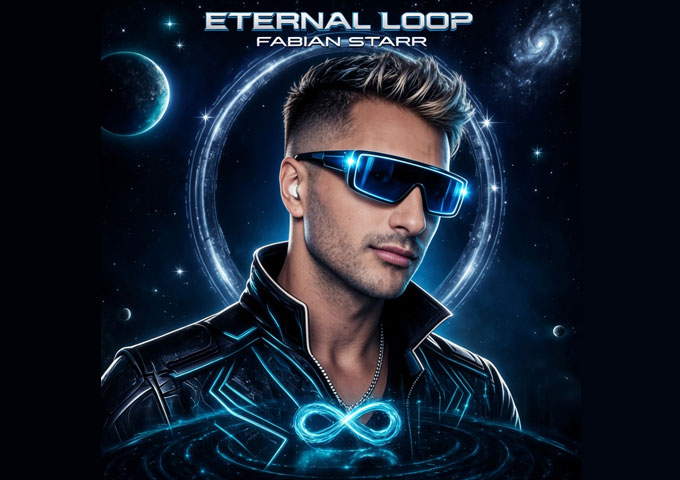
Sixteen tracks, eight chapters, one complete cycle from birth to rebirth The electronic composer follows up the dancefloor energy of Back to the Arcade with something far more introspective Eternal Loop arrives September 16, 2026, and it does not so much end as return to where it began
Some artists chase a single mood across an album. Fabian Starr has set out to chase an entire lifetime. With Eternal Loop, the veteran electronic composer and songwriter is releasing a sixteen-track concept album that maps the full arc of human existence, from the disorientation of first breath to the quiet clarity of old age, and then, somehow, back around again. The album lands September 16, 2026, across all major streaming platforms, and it marks a deliberate turn away from the club-ready sound that defined his previous release.
That previous release, Back to the Arcade, was built for movement. It drew on Starr’s decades of firsthand experience behind the lighting board at Charleston’s legendary Arcade Club during the Hi-NRG explosion of the 1990s, a period during which he learned, viscerally, what makes a crowded room move as one body. Eternal Loop is its mirror image. Where the earlier album lived on the dancefloor, this one lives in the quieter rooms of memory, longing, and reflection. As Starr puts it, “This album is the other side of my universe. Back to the Arcade was the dancefloor. Eternal Loop is everything that happens in a lifetime.”
That framing is not a marketing flourish. It is structural. Eternal Loop is organized into eight distinct chapters, each one a stage of human experience rendered in sound rather than narration. The album opens with “First Light,” a meditation on birth and arrival built from synthesizer textures that feel less like an introduction and more like an awakening. From there, the record moves through “becoming,” which traces the slow, often clumsy process of forming an identity, and into “Heavy Days,” a chapter that sits with the weight of adulthood without flinching from it. The journey continues through moments of ambition and acceleration on tracks like “Escape Velocity” and “Rising,” before settling into the reflective calm of “Wisdom Hour” and “Golden Evening.” By the time listeners reach “Between Worlds” and the title track “The Loop,” the album has stopped moving forward in any conventional sense and started curving back toward its own origin.
That circularity is the album’s central idea, and it is baked into the tracklist itself. “First Light” reappears near the record’s close in reprise form, a compositional choice that turns the entire sixteen-track sequence into a closed loop rather than a straight line. The album does not end so much as it folds back into its own beginning, a structural echo of the cyclical themes “Dragon Year,” “Messages from Tomorrow,” “Infinite Now,” “Revelations,” and closing track “The Garden” all explore in their own ways. Rather than resolving into a tidy conclusion, Eternal Loop insists that endings and beginnings are the same event viewed from different angles.
Sonically, Fabian Starr builds this world using synthesizers, what he describes as orbital atmospheres, and a cinematic production approach that consistently withholds easy resolution. That refusal to resolve is intentional. Chord progressions hang, arrangements breathe rather than build to predictable climaxes, and the overall effect is a record that feels suspended in time even as it moves through it, a sonic embodiment of the cyclical nature of existence the album is built around.
None of this would land with the same weight if it came from a producer working purely in loops and presets, and this is where Starr’s background becomes essential to understanding the record. With more than thirty years of experience across original composition, live performance, and film and television scoring, Starr approaches electronic music from a songwriter’s vantage point first. His classical training shapes nearly every compositional decision on Eternal Loop: chord progressions borrow from jazz harmonic theory, arrangement choices account for counterpoint and voice leading, and vocal elements receive the same careful treatment typically reserved for orchestral writing. It is an approach that treats melody, harmony, and emotional arc as the foundation of a track, with production layered on top rather than the other way around. The result is music that sounds composed rather than assembled, carrying the kind of narrative weight more commonly associated with scored film sequences than club records.
That dual fluency, between dancefloor instinct and classical songcraft, is precisely what makes Starr an unusual voice in contemporary synthwave and nu-disco. Based between Los Angeles, California, and Charlotte, North Carolina, he has spent three decades observing how music moves people across wildly different settings: nightclubs where the priority is physical momentum, concert halls where the priority is emotional arc, and film audiences where the priority is narrative support. Eternal Loop feels like the album where all three of those instincts converge. It is rhythmically aware without being built around a beat, cinematically scaled without being merely atmospheric, and emotionally direct without leaning on lyrical exposition to get there.
Ahead of the full release, fans can already step into the world of Eternal Loop through an interactive preview experience. The opening track “First Light” is available to hear in full, all sixteen tracks can be sampled, and the album is now open for presave, with vinyl, streaming, and sharing options also available. It is a fitting way to introduce a record built around the idea of a threshold, since “First Light” functions as both the album’s literal opening statement and, in its reprised form near the end, a kind of doorway back into the beginning.
What makes Eternal Loop compelling is not simply its ambition, though a sixteen-track, eight-chapter concept record spanning an entire human lifespan is undeniably ambitious. It is the way Starr resists the temptation to resolve that ambition into something neat. Life, as the album seems to argue, does not move in a straight line from birth to transcendence and stop there. It circles back on itself, revisits its own beginnings, and finds meaning in repetition as much as in progress. By structuring the album as a loop rather than a line, and by refusing musical resolution as a formal device rather than an accident, Fabian Starr has built a record that mirrors its subject matter with unusual precision.
Eternal Loop releases September 16, 2026. Fans of Back to the Arcade should not expect a repeat of that record’s dancefloor urgency here. What they will find instead is a more patient, more searching companion piece from an artist whose thirty-year relationship with both crowds and composition has clearly given him plenty to say about everything that happens between one first light and the next.
OFFICIAL LINKS: https://fabianstarr.com/home